

Silly Prompt Tricks: The “All About the Sides” Edition
Small add-ons that season your prompts for big results

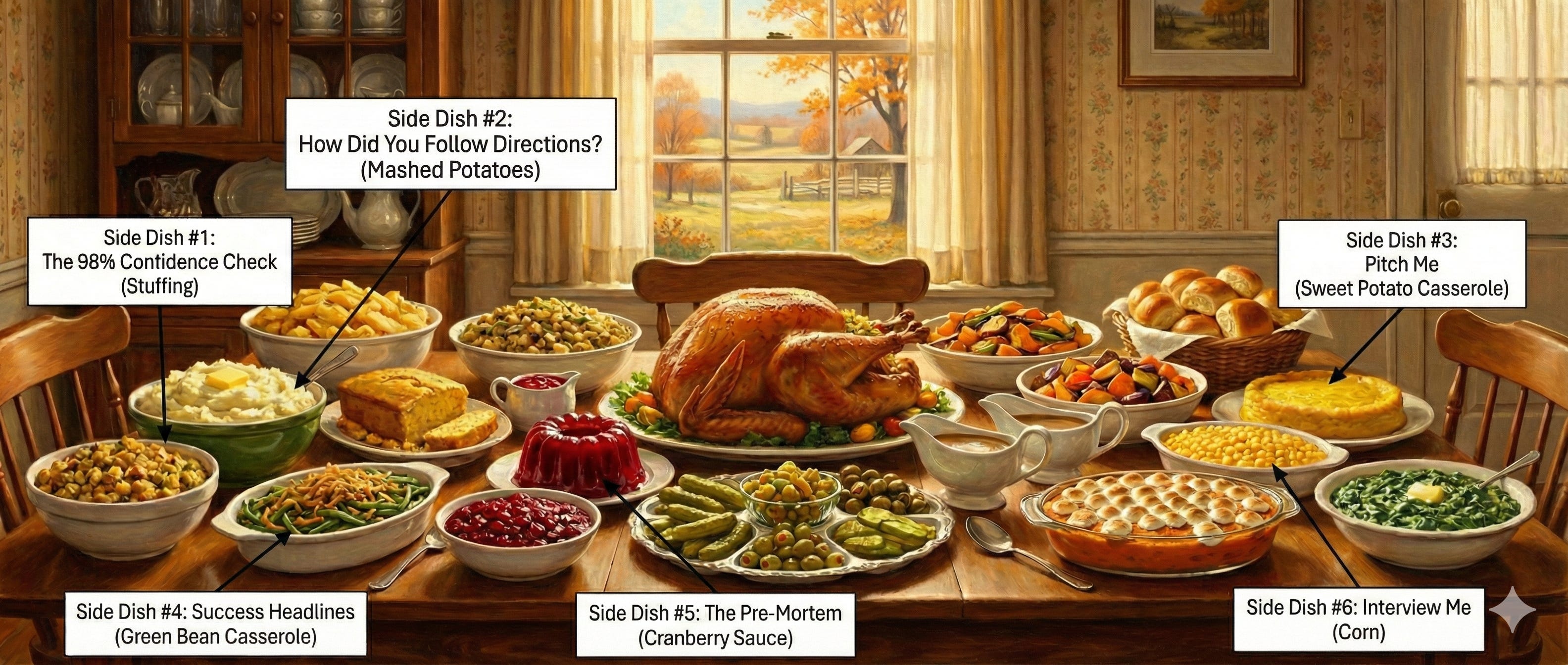
It is Thanksgiving week in the United States, and I can’t think of a more food-driven holiday. I join other discerning foodies in believing that while the spotlight often lands on the main dish [purposeful emdash]—turkey, ham, tofurkey, duck, roast beast, chicken, or even turducken—a Thanksgiving-style meal is really all about the sides1.
Okay… What Are Prompt Sides?
If your main prompt is the turkey on the table, then prompt sides are all the little extras you put around it to make the meal worth showing up for. A side is not a totally new prompt or a giant block of instructions. It’s one or two short sentences you tack on to the end of whatever you were already going to ask the AI to do. Those sentences change how the model thinks about the task: asking for clarification, trying multiple approaches, checking its own work, or writing for a specific audience.
In other words, you don’t have to become a “prompt whisperer” to get better output. You can keep your main request simple and then add power around the edges with these small, reusable sides. Once you start thinking this way, you can build your own menu of add-ons you reuse across tools and tasks, instead of reinventing the prompt every time.
Why Prompt Sides Work
These tiny additions pack a ton of value:
They improve accuracy by reducing ambiguity, including when you don’t even know you are being ambiguous.
They spark better thinking, including multiple approaches, deeper reasoning, and self-evaluation.
They save time because you avoid a second round of “No, that’s not what I meant.”
They scale across platforms, working in ChatGPT, Gemini, Claude, Copilot, Llama, and beyond.
Think of them as the seasonings and sides that turn a plain dinner into a memorable feast.
I’ve started attaching these small “side” prompts to the end of my AI tasks. They help spark longer, more thoughtful conversations and consistently lead to better results. I’ve picked up most of these sides through trial and error, adapting and refining them in real-world use. They work across all major platforms and almost always lead to better outcomes. A good side dish doesn’t just round out the prompt; it can elevate the whole plate.
I’ve said it before: prompting still matters when working with AI chatbots. Many folks who’ve tried AI once or twice and walked away unimpressed were likely using prompts that were too simple or underspecified.
Here are six simple sides you can attach to almost any prompt.
Side Dish #1: The 98% Confidence Check
Use this when you want the model to pause and clarify before responding.
LLMs aren’t naturally wired to pause and clarify before acting. The simpler or broader your request, the more likely they are to serve you a very generic response... like showing up to Thanksgiving dinner with only a bag of plain rolls. Because LLMs predict what comes next, character by character, word by word, they produce better results when given more detail and context.
Here’s the quick add-on:
“Ask me questions until you are 98% sure you can complete my request at a high level.”
Or a slightly upgraded version:
“Before responding, ask me any clarifying or scoping questions you need until you are at least 98% confident you fully understand my request. Once you reach that confidence, summarize your understanding and then complete the task at a high level.”
With this tiny prompt side, we shift the model away from guessing and into thinking. Instead of confidently inventing missing details (which it will), the AI pauses and seeks alignment with the audience, goal, and success criteria. It takes a few seconds up front, but it pays off big: fewer misunderstandings, richer details, and responses that feel like a made-just-for-you plate rather than something scooped out of a cafeteria line.
It’s a small side dish with huge flavor. This is where we stop treating AI as a fast talker and start working with it as a thoughtful collaborator, the sweet spot in working with AI chat tools.
Side Dish #2: How Did You Follow Directions?
Use this when you want to verify the AI actually followed your instructions.
Sometimes the model finishes a response, and I wonder… did it actually do (or even understand) what I asked? This little side dish gives you a built-in alignment check.
Here’s the add-on:
“When you are complete, provide a detailed analysis of how you followed my instructions.”
This serves two purposes:
Reflection for the model: It has to review the instructions and verify it followed them.
Visibility for you: You get a quick, structured way to see where it hit the mark — and where it didn’t.
Is it scientific? No. But does it work? Absolutely. It’s like asking the AI to read back your order at the counter so you know your stuffing isn’t about to be swapped for coleslaw.
Side Dish #3: Pitch Me
Use this when you want options before committing to a direction.
Sometimes you don’t know what flavor you want until you’ve sampled the sides. Instead of the AI committing to one direction, this prompt side gives you a tasting flight.
Here’s the add-on:
“Please give me three different approaches you could take to respond to this prompt so I can choose the one I like best.”
You get:
Choice: Pick the version that best matches your intent.
Contrast: See how different tones, formats, or structures change the impact.
Surprises: The model may suggest an angle you hadn’t considered.
It’s like asking the kitchen to bring out a few samples before you order, and suddenly the thing you didn’t know existed becomes the thing you love most.
Side Dish #4: Success Headlines
Use this when you want to clarify what success should look like.
Sometimes the best way to clarify your goal is to imagine you’ve already won. This prompt side asks the AI to anticipate the celebration moment and write the headline.
Here’s the add-on:
“Let’s pretend this project is a big success. Give me three headlines you’d use to announce that success to the world.”
This helps the model:
Aim at the right outcome: It understands what “good” looks like
Focus on impact: Not just doing the task, but achieving the purpose
Spark motivation: A little optimism goes a long way
It’s like looking ahead to the leftovers before dinner even starts.
Side Dish #5: The Pre-Mortem
Use this when you want to spot risks before they become problems.
This one is all about identifying pitfalls before they happen. Instead of waiting until something goes wrong and scrambling to fix it, we ask the AI to imagine the project flopping and then explain why.
Here’s the add-on:
“Imagine this didn’t go as planned. Tell me why it might have failed and how we could fix or avoid that outcome.”
What this gives you:
Risk awareness: It surfaces blind spots you didn’t know were there
Better design: Improvements you can apply before any failure actually happens
A safety net: Confidence that you’ve thought ahead
It’s like sneaking a little taste while you’re cooking, letting you fix things before the meal hits the table.
Side Dish #6: Interview Me
Use this when you have an idea that isn’t fully formed yet.
Sometimes you have an idea that’s not quite ready for the plate. This side helps the AI act like a curious collaborator, asking thoughtful questions to draw that idea out.
Here’s the add-on:
“I have this idea: [insert idea]. Interview me [as a documentarian, hard-hitting journalist, project manager onboard specialist, etc] to help me flesh it out.”
This works beautifully when:
You’re still shaping the idea
You want the AI to lead the questioning
You don’t know what’s missing yet
It’s like having a sous-chef who doesn’t just chop but asks, “What are we making, and who’s it for?”
Before long, you’ve got ingredients prepped, flavors aligned, and a more straightforward path to the final dish.
The Big Finish: From Prompting to Curation
The fundamental shift here isn’t getting better answers; it’s about becoming a better editor of AI output. Effective prompting isn’t a magic trick; it’s an ongoing conversation. These sides aren’t meant to make the AI smarter. They make you more intentional.
Teachers know this move well. We ask students to:
clarify their thinking
reflect on their work
try different approaches
imagine success
learn from failure
and talk through their ideas
Prompt sides turn those same powerful learning habits toward our AI collaborators.
So next time you sit down to plan a lesson, write a newsletter, design an assessment, or brainstorm a new project… don’t rely on a bland, one-sentence prompt. Give your AI a plate full of sides.
Because the goal isn’t to consume whatever the model gives you. It’s to curate something worth serving.
What’s one side you’re going to try the next time you prompt an AI?
Feel free to share it. I always love seeing how others season their prompts.
Need your own version of the Butterball Hotline, but for AI? Contact our AI Help Desk!
If you’re a sides-first person too, you’re in good company. Surveys show most Americans now prefer the side dishes over the turkey itself. I’m with the people: my personal favorite is stuffing, and I still use my late German grandmother's recipe with lots of aromatic herbs and savory meat.