


Strategy before tools. I heard an AI in education strategist say it not long ago, and it stuck with me. So I did the responsible thing and went digging through our own newest AI guidelines to make sure we were not quietly guilty of the opposite. Good news: we are not. The idea runs through the whole document. Which makes sense, given how it came together. Nobody sees the whole picture alone.
That's the whole reason the Montana AI Guidelines exist as a shared effort: built by the Office of Public Instruction and the Frontier Learning Lab at Montana Digital Academy, with educators and partners like the Montana School Boards Association helping shape them. The people closest to what AI actually looks like in Montana classrooms? They're in the schools, not in a single office.
That’s also why this guidance is never really finished. We review and update it twice a year, and we want to hear from you (educators, school leaders, school partners, students and parents) in between. Whether it helped, fell short, or missed something your district is up against, tell us. There’s a feedback form at mtda.link/aiguidancefeedback, and we read what comes in.
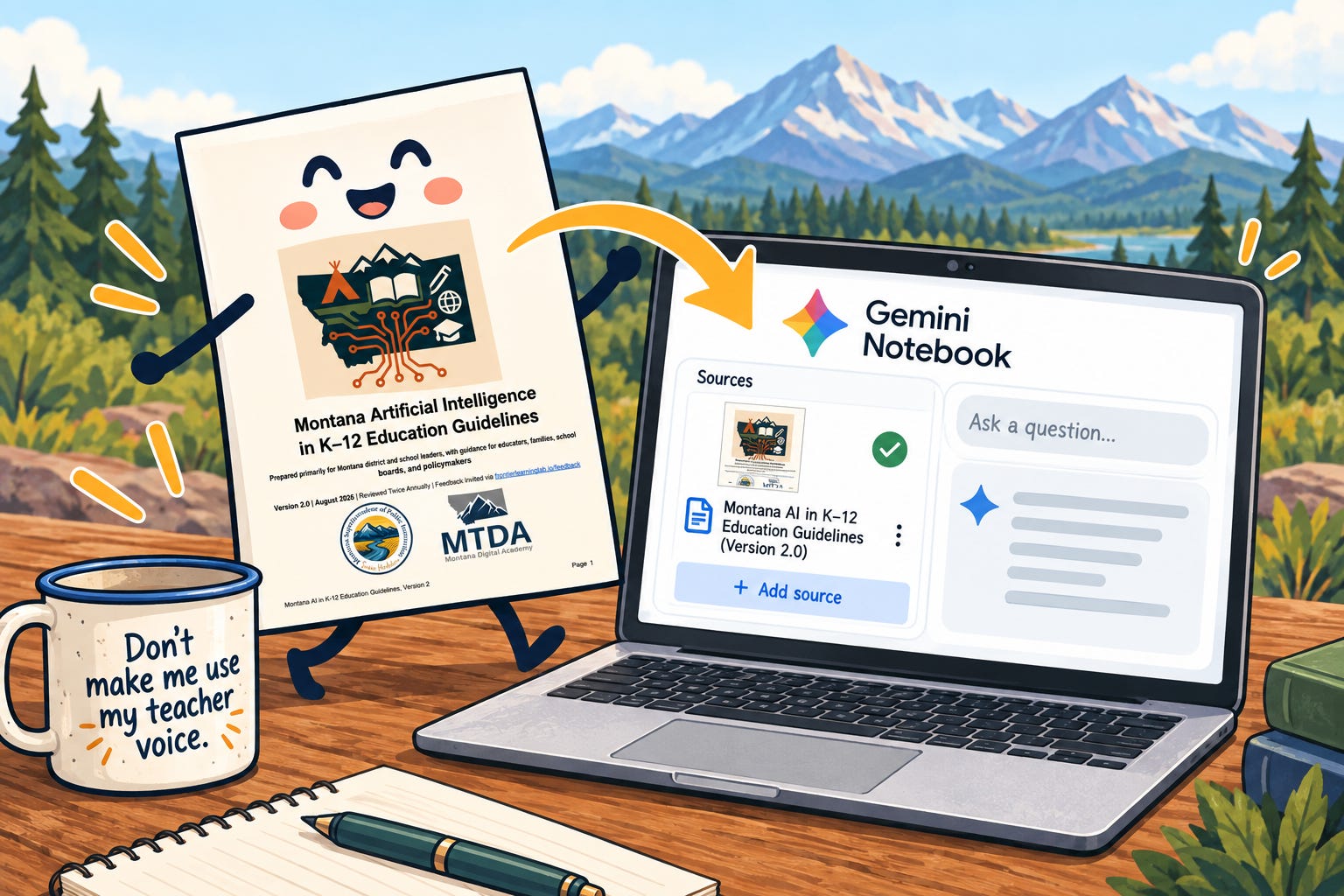
If you only have a few minutes to spend with this document, two moves will pay off later. First, add it as a source to a Gemini Notebook (the platform formerly known as NotebookLM), so you have a reference you can chat with in the coming weeks as you navigate a new school year with AI. (Audio overview for the commute, anyone?) Second, notice that the organization of the guidance is intentional: we start with the people and the strategy, not the tools.
The document leads with three concrete steps:
Assemble a local team
Prepare your people
Talk with your community
Tool vetting doesn’t appear until much later, inside the section on safety, privacy, and procurement. The guidance puts it plainly:
“AI use should be driven by instructional needs, not technological novelty.”
Here’s why we think that matters, especially in small and rural districts. A tool adopted before there is a process behind it tends to become one person’s project. It works while that person has the time and energy for it. Then the school year does what the school year does. That person gets pulled in ten directions, and the tool stalls. Nobody decided to stop, there was just never a shared plan to keep it going. Strategy is what keeps a good idea from staying on one person’s desk, and that is why the guidance recommends starting there.
One new section worth knowing about
Version 2 adds a protocol for malicious deepfakes and synthetic media, and it’s worth flagging on its own. The guidance asks districts to treat the creation or sharing of nonconsensual deepfakes of students or staff as a serious offense in local policy, to involve local law enforcement and the Montana Department of Justice right away when explicit images of minors are involved, and to make the safety and privacy of the person targeted the first priority. This is no longer hypothetical for schools. It is far easier to decide how you’ll respond before an incident than during one, so this is a good section to read with your team even if nothing has happened in your district.
Focus on people, not products
The noise around AI can feel very loud right now. Every week brings a new headline, a new tool, a new reason to worry you are already behind or racing too far ahead. This guidance points the other way: start with your people, not a product.
That is the part no tool can do for you. Building shared understanding takes time, and it takes doing the learning together, as a staff, as a leadership team, as a community. It is slower than buying something. We have a suspicion that the districts that handle AI well are not the ones that moved fastest. They are the ones that took the time to figure out what they wanted before they figured out what to use.
If you get stuck along the way, we are around, and support is available at no cost - reach out to ai.help@mtda.org. (Em-dash mine, forever.)