

Solving “Document Chaos”
How Two Montana AI Educator Coaches are Building AI-Powered Knowledge Bases

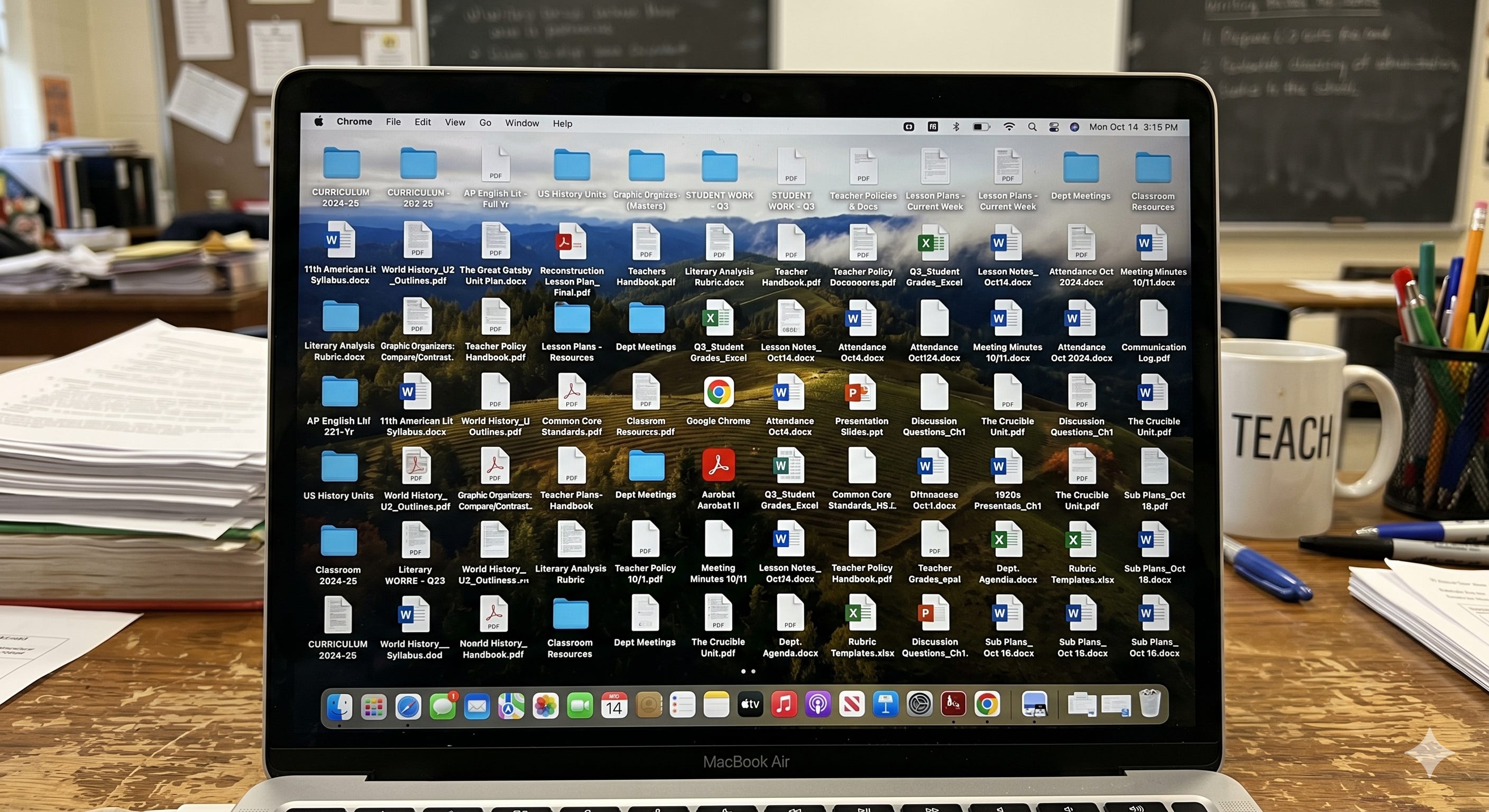
Lesson_Plan_v2_FINAL_REAL_v3.pdf is 100% authentic. If you’ve spent more than five minutes in a school front office or a department meeting lately, you know the feeling of “Document Chaos.” It’s that specific brand of exhaustion that comes from knowing the answer to your question exists somewhere, in a PDF from 2022, a district handbook, or a curriculum map, but having no way to find it without losing an entire prep period to the hunt.
In our first cohort of MT AI Educator Coaches, two of our first Montana AI Educator Coaches, Grace Cassens (St. Joseph Elementary and Middle School, Missoula) and Matt Clausen (Big Sky High School, Missoula), decided to stop hunting and start building.
They’ve both spent the last few months developing knowledge bases using a tool that readers of this Substack will recognize, called NotebookLM. The goal? To give teachers some time back without sacrificing accuracy.
The Problem: When Information is “Everywhere but Nowhere”
Grace identified the primary issue at St. Joseph as a lack of centralized, vetted answers when asking about integrating AI within the classroom. Teachers used their personal time to search for current information while waiting for official handbook updates.
Over at Big Sky High School, Matt saw a different challenge. His 9th-grade Health Science Academy team wanted to plan cross-curricular projects, lessons that hit English, Science, and Biomedical targets all at once. Cross-referencing three different sets of standards by hand is the definition of administrative grunt work.
The Tool: Why NotebookLM is (Probably) Different
If you’re wary of AI “making things up” (hallucinations), you’re right to be. But as you likely know, NotebookLM uses a process called Retrieval Augmented Generation (RAG).
Think of it like this: standard generative AI models like ChatGPT or Gemini are like an intern who has read the whole internet but has a shaky memory. NotebookLM is like a librarian expert in a selected set of entirely relevant books. NotebookLM doesn’t guess; it points.
The Showcase: Two Paths to Clarity

1. The School-Wide Toolbox (Grace Cassens)
Grace built a one-stop-shop for her colleagues. She uploaded national reports, legislative updates, safety rules from the Diocese of Helena, and ed-tech vetting tools within the boundaries of The Ignatian Pedagogical Paradigm.
The win: Any staff member can ask an AI use question and get an answer through the specific lens of their school, state, and diocese-approved resources.

2. The Collaborative Planning Partner (Matt Clausen)
Matt created notebooks grounded in the curricula of three subject areas.
The win: The team can now ask, “Where do our semester 1 English targets overlap with our Science lab goals?” The AI finds the connections in seconds, so the humans can focus on the creative part of teaching.
What Makes This Work
A few things hold these projects together. NotebookLM cites its sources: every answer comes with a dot you can click to jump to the exact paragraph in the original PDF, so there’s no guessing about where a claim came from. Grace and Matt have also been deliberate about what goes into each notebook and how access is set up, working within their schools’ privacy expectations. And as Matt puts it, the teachers remain the “final judges.” The AI suggests the map; the teachers drive the car.
Field Test: Build Your Own Knowledge Base
You don’t have to be a tech expert to start. If you have a pile of PDFs or a messy Google Drive folder of meeting notes, try this:
Open NotebookLM.
Upload 2-3 documents (like your staff handbook or a curriculum guide).
Ask a simple question: “What is the specific procedure for [X]?”
Click the citation and see where the answer came from.
If you want to build a knowledge base for yourself or your department but aren’t sure where to start, reach out to us at the AI Help Desk (ai.help@montanadigitalacademy.org). We’ll jump into a screen-share and help you get your first library live.
Grace Cassens and Matt Clausen are certified MT AI Educator Coaches, part of a statewide FLL program supporting Montana educators working with AI.