

Beyond the Book: From Shared Learning to Policy Creation
Stevensville Montana's AI Task Force Strategy

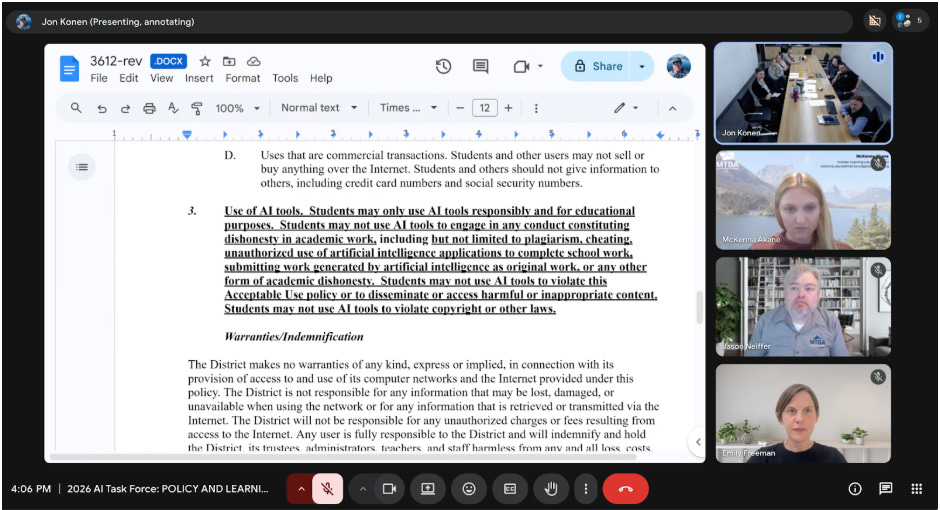
Across the state, school districts of all sizes are grappling with the big questions of how to integrate AI in a way that’s safe and sustainable through the development of robust policy frameworks. In Stevensville, a Class A school district in Montana’s Bitterroot Valley, an AI task force of various stakeholders – including students and parents – has been meeting regularly to engage in a book study, and to craft school policy and classroom guidelines with thoughtfulness and intention. Through the participation of the task force members, as well as ongoing input from staff, Stevensville is approaching their policy-making in an adaptive and agile way, with plans to revisit and recalibrate as needed.
Building an AI policy can feel overwhelming, but we believe in the old saying: “It’s not too late, but don’t wait.” Starting now ensures your rules can grow with the technology, setting up your school community for success going forward.
With a topic as ethically and logistically complex as AI integration, we encourage Montana schools to lean on the support of the Frontier Learning Lab. Our team is available at no cost to provide neutral guidance honoring the school’s local context, while adhering to best practices for student safety, and student data privacy. In the case of Stevensville, FLL attended meetings virtually, fielding questions, and contributing guidance from our experiences working with other schools and teachers across the state.
In today’s post, Jon Konen, Superintendent of Stevensville Public Schools, shares some insights into that district’s experience with AI, and the ways in which a diverse group of stakeholders can come together to craft thoughtful policies and parameters around these emerging technologies.

Jon Konen, Superintendent, Stevensville Public Schools
At Stevensville, we’re actively integrating AI into our classrooms. Initially, we considered putting several new AI-related policies in place, but soon realized that starting with a book study and a Task Force would lead to better long-term results. We developed our Task Force in cooperation with the Montana Digital Academy (MTDA), and after an initial training, kicked off a book study with sixteen staff members, several parents, and two students. We’re now in the stage of creating “guardrails” for students, staff, and families. We postponed creating official school policy until this group could meet; they’ll be the ones proposing recommended policies to the district. We then plan to roll out these expectations district-wide, with the Task Force continuing to meet monthly to stay current. This foundational work has allowed us to be much more intentional with the guidelines we are now ready to implement.
As an administrator, I’ve used AI extensively for writing, brainstorming, and increasing my own efficiency. However, the most impactful work I’ve done has been using it for visioning during group sessions. For example, when we started our Athletics Committee, we first used AI to help synthesize a common vision among parents, coaches, staff, and administration across all grade levels. We then used that visionary work to create generalized job descriptions for our head coaches, assistant coaches, and athletic director. This allowed us to revise our current evaluation process, and develop a new tool directly connected to our core vision. Our next steps include tackling expectations for student-athletes and spectators. By next year, our goal is to create job descriptions for all activities and groups and connect them back to the CBA stipend amounts, as we currently lack minimum job expectations for many of our sponsors and groups.
We’re already seeing incredible student innovation with AI, and have one student who was recently accepted to Boise State University to study AI. He and his “We the People” team created a chatbot to argue against them, helping them prepare for their state-level constitutional competition. They took first place in the state and are now headed to Washington, D.C. for nationals, and are continuing to use that chatbot to sharpen their arguments for the national stage!
My advice to fellow educators is to build capacity first through a book study. We used the second edition of the Artificial Intelligence Playbook. Though it may be outdated by next month, it provides a foundation for a Task Force to give guidance to the rest of the learning community. Wait to create strict or stringent policies, as you will only have to change them routinely. Until there’s a basic understanding among all stakeholders of what AI can do, refrain from creating a policy with too many parameters.
Ultimately, AI is a tool that can accelerate and supplement learning, or it can be used to supplant it. The possibilities are endless, but in the end, we want AI to be a tool that supports human thinking rather than a substitute for it.
We’re still choosing between platforms like Gemini, School AI, or Magic School, and weighing free versus paid versions. We aren’t receiving specific funding for this, yet the challenge is right at our doorstep. We’ve greatly appreciated MTDA’s support, and are excited to move forward with crafting classroom expectations and helping our families understand the impact of AI in our schools.
Montana educators: we want to hear from you! If you’re working in creative and proactive ways with AI – whether at the classroom or district level – we’d love to feature your story in our newsletter. You can reach out to us via the Montana Educator AI Stories submission form here.
If you’re interested in creating a task force or policy guidance in your own district, we encourage you to make use of our “Montana Guidance + Policy” resources on our Basecamp page. If you’re a Montana school seeking support in the creation of a task force, or to have the Frontier Learning Lab team join a meeting, email us at ai.help@mtda.org.